
The Bullish Engulfing pattern is one of the most accurate candlestick patterns traders rely on when trying to catch market reversals.
But most traders completely ignore the Piercing Pattern — a powerful reversal signal that can be just as effective when used correctly.
At first glance, both patterns may look similar.
However, they reveal different levels of strength, different market psychology, and different trading opportunities.
If you treat them the same way, you will make poor trading decisions.
In this guide, you will discover the key differences between the Piercing Pattern and the Bullish Engulfing, and how to use each one correctly based on market context.
Piercing Pattern vs Bullish Engulfing
Let’s start with the Bullish Engulfing pattern.

This is a two-candle formation where the second candle completely covers the body of the first one.
In simple terms, a strong bullish candle follows a bearish candle and fully “engulfs” it.
This shift shows that buyers have stepped in aggressively and taken control of the market.
When this pattern appears after a decline, it can signal that the market is preparing for a potential reversal to the upside.
We cover this setup in detail in our bullish engulfing candlestick pattern complete guide.
Now let’s look at the Piercing Pattern.
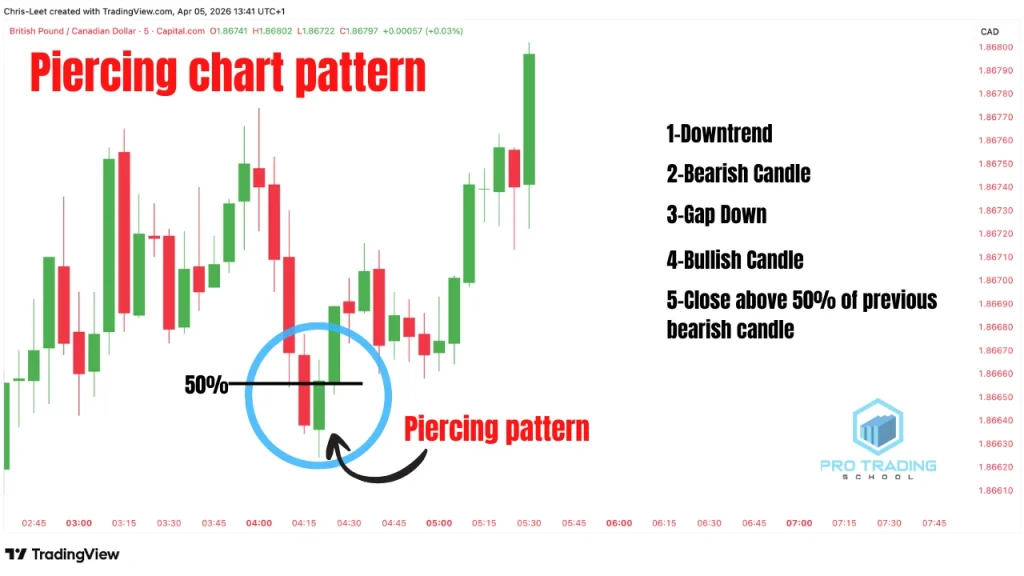
This is also a two-candle formation, but the structure is slightly different.
The first candle is a strong bearish candle, showing clear selling pressure.
The second candle opens below the previous close, suggesting that sellers are still in control at the beginning.
However, buyers step in and push the price higher, closing the candle above the midpoint of the first candle’s body.
Unlike the Bullish Engulfing pattern, the second candle does not fully cover the first one.
This tells us that buyers are gaining strength — but they have not completely taken control yet.
Key Differences Between Piercing Pattern and Bullish Engulfing
At first glance, the Piercing Pattern and the Bullish Engulfing may appear similar — but they are not equal.
They differ in their anatomy, the psychology behind them, and the strength of the signal they provide. And because of that, each pattern requires a different approach when trading.
The table below breaks down the key differences you need to understand to avoid common mistakes and improve your decision-making.
| Feature | Bullish Engulfing | Piercing Pattern |
| Buyer Strength | Strong and dominant | Emerging strength |
| Candle Structure | Fully engulfs previous body | Closes above midpoint only |
| Market Control | Buyers take full control | Buyers gaining control |
| Signal Type | Strong reversal or continuation | Early reversal signal |
| Reliability | Higher | Moderate |
| Confirmation Needed | Sometimes optional | Strongly recommended |
| Best Context | Support, liquidity sweep, retest | Early reversal, range |
| Risk-to-Reward | Often better | Can be less favorable |
The Psychological Difference Between the Piercing Pattern and the Bullish Engulfing
The psychology behind the Bullish Engulfing pattern is stronger.
This pattern shows that buyers have stepped in aggressively and completely taken control of the market.
When it appears in the right context — such as at a key support level after a downtrend — it can signal a strong bullish reversal.

As you will see in the chart example above, the market was moving lower, but once the Bullish Engulfing pattern formed at support, buyers overwhelmed sellers and pushed price in the opposite direction.
The psychology behind the Piercing Pattern is slightly different.
This pattern shows that buyers are starting to gain strength, but they have not fully taken control yet.
Because the second candle closes above the midpoint of the first candle without fully engulfing it, the signal is still less decisive than a Bullish Engulfing pattern.
It is still a valid bullish signal, but it usually requires more confluence and confirmation before entering a trade.
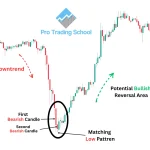
Look at the chart example below.
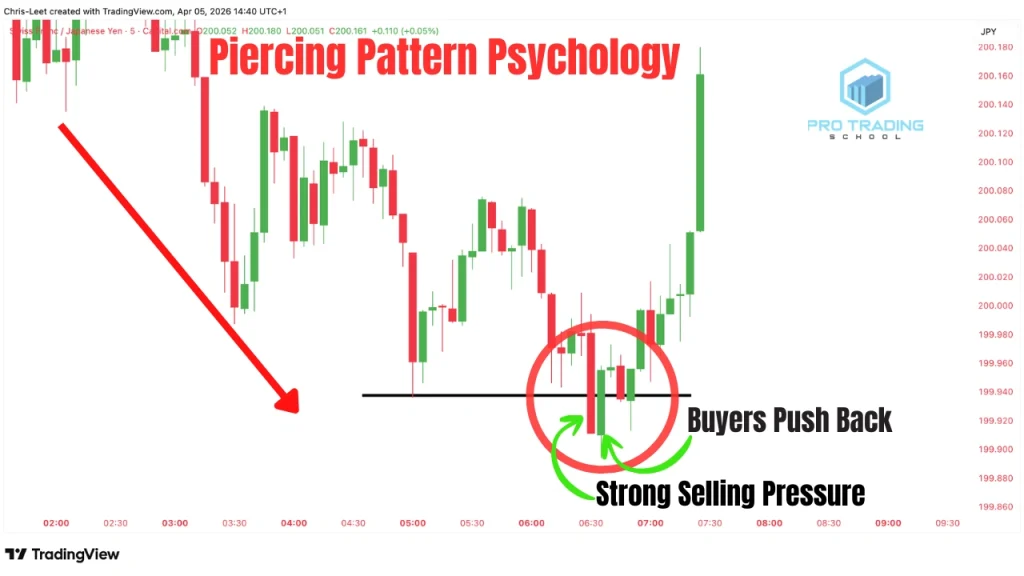
As you can see, the market was trending downward and then reached a clear support level.
At that point, a Piercing Pattern appeared, showing that buyers were beginning to push back against the selling pressure.
However, this alone is not always enough.
To increase the probability of the setup, traders often wait for additional confirmation — such as a bullish candle closing above the high of the Piercing Pattern or other confluence factors supporting the reversal.
Bullish Engulfing vs Piercing Pattern: Reversal vs Continuation Signals
One important difference between the Bullish Engulfing pattern and the Piercing Pattern is how they can be used in different market conditions.
The Bullish Engulfing pattern is flexible.
It can act as a reversal signal when it forms at the end of a downtrend, indicating that buyers are taking control and the market may move higher.
But it can also act as a continuation pattern when it appears during an uptrend, especially after a pullback to a key level.
In this case, it signals that buyers are stepping back in to continue the trend.
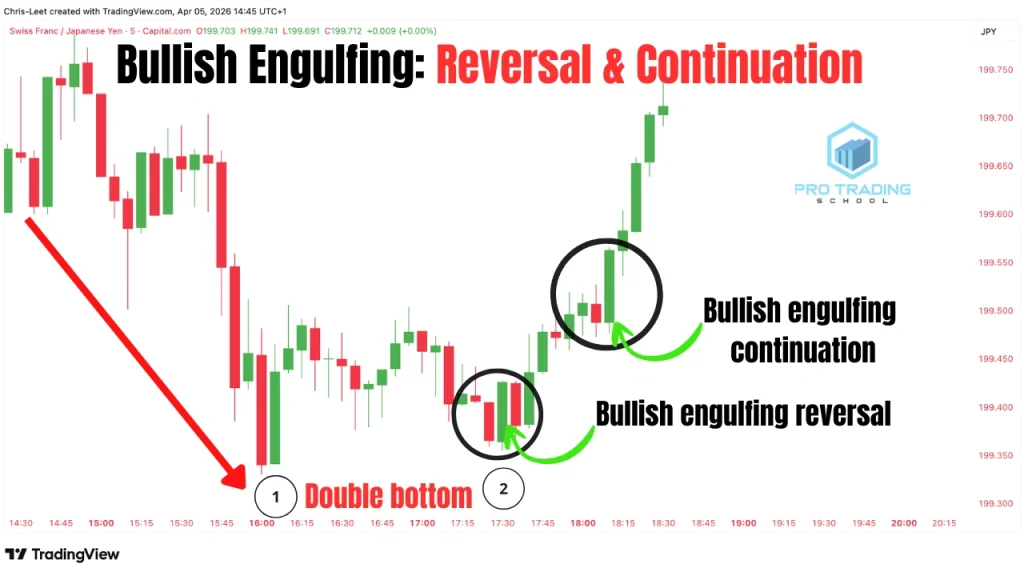
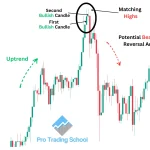
As you can see in the chart example above, the Bullish Engulfing pattern first appears at the end of a downtrend and leads to a reversal.
Later, it forms again during the uptrend, providing another opportunity to enter in the direction of the trend.
Here are some bullish engulfing pattern chart examples to help you understand how this setup works in real market conditions.
The Piercing Pattern, on the other hand, is mainly considered a reversal pattern.
Because it does not show full buyer dominance, it is generally not strong enough to be used as a continuation signal.
While some traders may attempt to use it during an uptrend as a continuation setup, this approach is riskier and requires strong confirmation and additional confluence.
Bullish Engulfing vs Piercing Pattern: Reliability Difference
The Bullish Engulfing pattern is generally considered a strong and reliable signal.
When it forms, it clearly shows that buyers have taken full control of the market.
If this happens in the right context — such as at a key support level after a downtrend — it can provide a high-probability reversal signal.
In these situations, the shift in momentum is clear and decisive, which is why many traders are confident entering trades based on this pattern alone, especially when combined with other confluence factors.
The Piercing Pattern, on the other hand, is more moderate in terms of reliability.
Although it shows that buyers are stepping in, they have not fully taken control yet.
This makes the signal less decisive and more dependent on confirmation.
Look at the chart example below.

As you can see, the market was trending downward before reaching a key support level.
A Piercing Pattern then formed, indicating that buyers were beginning to push back.
However, this alone is not enough to confidently enter a trade.
To increase the probability of success, traders typically wait for an additional bullish candle to confirm the signal — for example, a candle that closes higher and shows continued buying pressure.
As shown in the example, the next bullish candle confirms the setup and validates the reversal.
Without this confirmation, entering too early can lead to false signals and potential losses.
Bullish Engulfing vs Piercing Pattern: Risk-to-Reward Difference
The Bullish Engulfing pattern often provides a more favorable risk-to-reward ratio.
Because the pattern shows strong and immediate buyer control, traders can enter earlier — sometimes directly on the close of the engulfing candle or on a small pullback.
This allows for tighter stop-loss placement and better reward potential relative to the risk.
In addition, the clarity of the signal often leads to a higher win rate when the pattern is used in the right market context.
To improve your accuracy, learn how to confirm a bullish engulfing candle before entering a trade.
The Piercing Pattern, on the other hand, can be less favorable in terms of risk-to-reward.
Since the pattern does not show full buyer dominance, traders usually wait for an additional confirmation candle before entering the trade.
This delayed entry often means entering at a higher price, which increases the stop distance or reduces the potential reward.
As a result, the overall risk-to-reward ratio becomes less attractive compared to a Bullish Engulfing setup.
Moreover, because the signal is less decisive, the win rate can also be lower if the pattern is traded without proper confirmation and confluence.
Conclusion
The Piercing Pattern and the Bullish Engulfing pattern may look similar at first glance, but they represent different levels of strength and market control.
The Bullish Engulfing pattern shows a clear and decisive shift where buyers take full control, making it a stronger and more reliable signal that can be used for both reversals and continuation setups.
The Piercing Pattern, on the other hand, signals that buyers are starting to gain strength, but the move is not fully confirmed yet.
This is why it often requires additional confirmation and a more cautious trading approach.
In the end, the pattern itself is not what makes a trade successful.
It’s the context, confirmation, and your execution that truly matter.
A weaker pattern in the right context can outperform a strong pattern used incorrectly.


Chris you are amazing!!!!!
I have become a much more profitable trader since I stumbled on your video on YouTube and I have shared your videos with a lot of people who have testified.